
A Nerve Conduction Study, also known as an NCS, is one of the most common tests used to figure out why a nerve isn’t sending signals the way it should. Physicians often order it for symptoms such as a tingling hand or unexplained leg weakness. It’s typically done in a single office visit, with the combined NCS and EMG (electromyography) usually taking 30 to 60 minutes.
Here’s what the test measures, how it works step by step, and what happens once it’s finished.
What Does a Nerve Conduction Study Measure?
Your nerves work like electrical wiring, carrying signals between your brain and the rest of your body. Touch something hot and a signal travels from your hand to your brain almost instantly. Your brain sends a signal back down that same kind of wiring to tell your muscles to move. A nerve conduction study, or NCS, measures two things about that wiring. It will determine how fast a signal travels along a specific nerve and how strong it is by the time it reaches the nerve.
When a nerve is compressed, inflamed, or damaged, the signal traveling through it slows down or loses strength, and that change shows up clearly on the test. Your doctor may have ordered an NCS because you’re dealing with numbness, tingling, weakness, or pain, and the results can point to exactly which nerve is involved and how severe the problem has become.
This kind of testing helps sort out conditions such as carpal tunnel syndrome, diabetic neuropathy, and pinched nerves in the neck or lower back, each of which produces a slightly different pattern on the test.
How Does NCS Differ From EMG?
NCS and EMG get mentioned in the same breath so often that people sometimes assume they’re the same test. They’re usually performed back-to-back in the same appointment, but they measure two different things.
An NCS looks at the nerve itself. Small electrodes are placed on the skin over the nerve being tested, similar to the electrodes used for an EKG. One electrode delivers a mild electrical pulse, and the others record how quickly that signal travels and how strong it is by the time it arrives.
EMG looks at the muscle instead. Electromyography measures the electrical activity in a muscle using a thin needle placed just beneath the skin, rather than the surface electrodes used for an NCS. Together, the two tests tell a more complete story than either one alone. A slowed nerve signal shows where the problem sits, and abnormal muscle activity confirms whether that nerve problem is really reaching the muscle it serves.
What Happens During the Test?
Placing the Electrodes
The technologist starts by cleaning the skin over the nerve being tested, since oil or lotion can interfere with the readings. Flat metal electrodes go over two points along the nerve’s path, taped or held gently in place. One acts as the stimulator, and the other records the response farther down the nerve.
The Stimulus and the Response
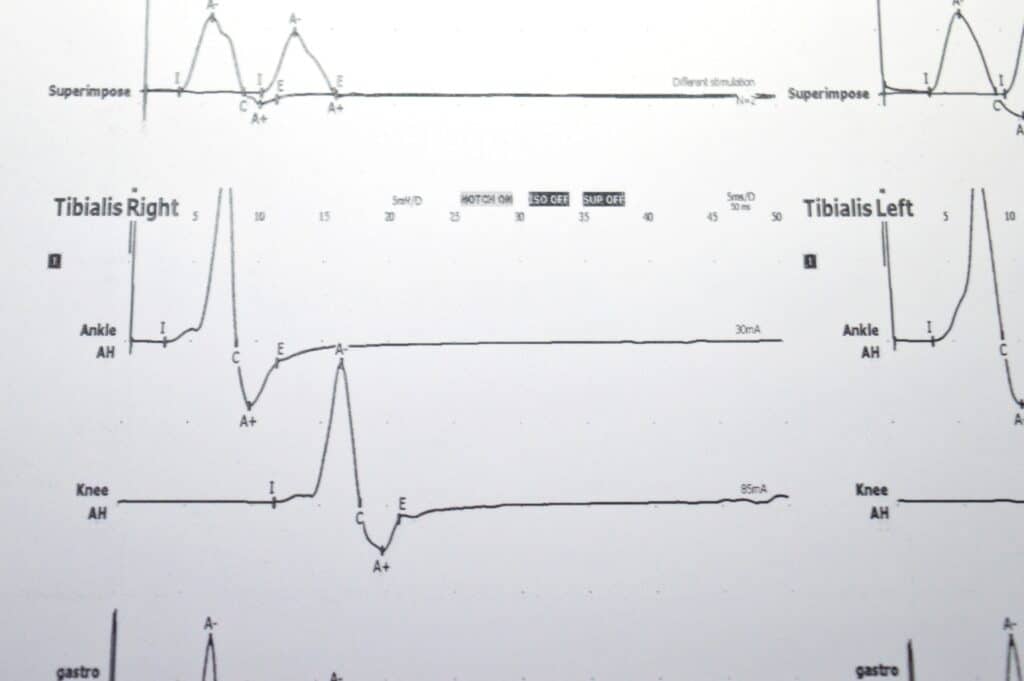
The stimulating electrode delivers a brief, mild electrical pulse that lasts less than a second. Most people feel a quick tingling sensation or a small muscle twitch, not unlike a light static shock. That pulse triggers the nerve to fire, and the recording electrode captures how long the signal took to arrive and how strong it was when it got there. A machine converts that information into a wave pattern the physician can measure, showing conduction velocity and amplitude, the two main numbers used to judge how well a nerve is working.
Testing Multiple Nerve Sites
Most appointments involve testing more than one nerve, and sometimes both sides of the body for comparison. The technologist repeats the process at each site, moving the electrodes to a new location for every nerve being evaluated. A physician or a certified nerve conduction technologist can perform this part of the test, though a physician always reviews the complete set of results afterward.
Curious what a nerve conduction study might reveal about your symptoms? Schedule an appointment at Bingham Nerve & Muscle at one of our locations in Mississippi or Tennessee.